Next.js is not only a React frontend framework. With Route Handlers, Server Actions, SSR/SSG, and edge runtimes, many teams consolidate UI and API into one TypeScript codebase — and leave split Node.js or PHP stacks behind.
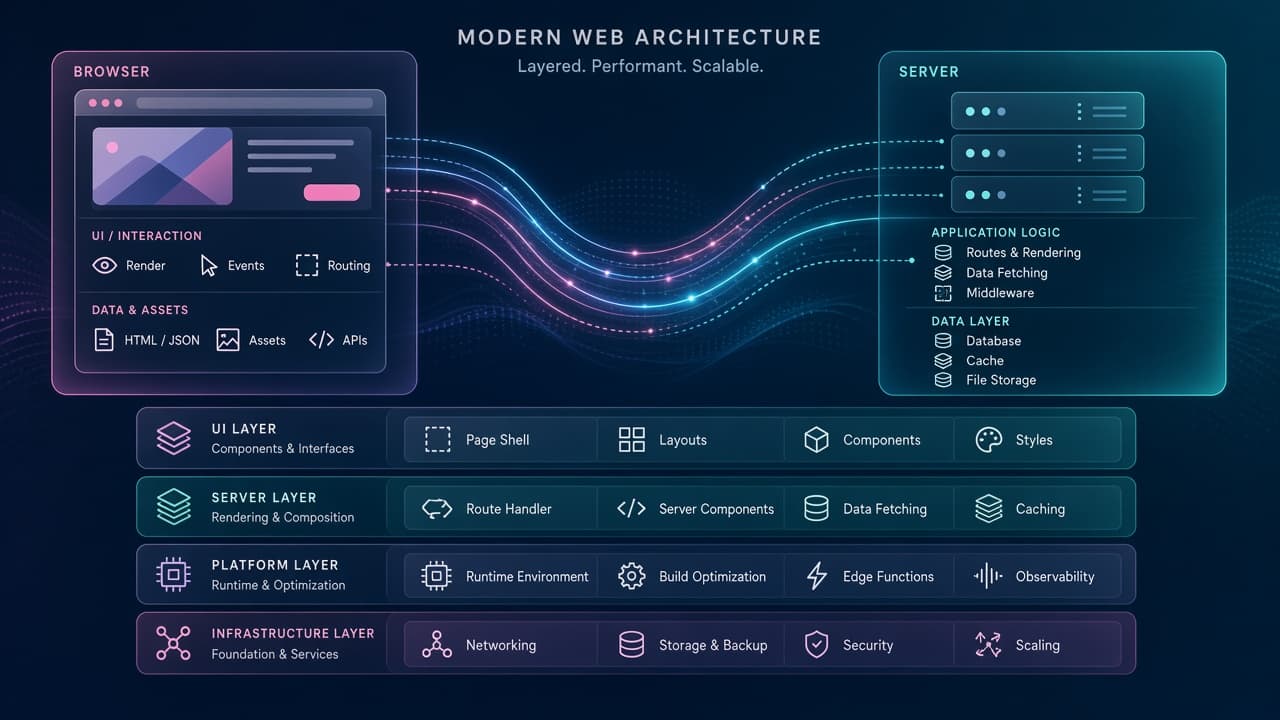
What “Next.js as backend” means
In the App Router, you can build APIs with Route Handlers, run server-only logic with Server Components and Server Actions, talk to databases from the server, and still ship a fast React UI from the same project.
That is different from classic PHP apps (page templates + separate frontend) and from a pure Express/Nest Node.js API that stays disconnected from the UI repo.
Benefits versus plain Node.js backends
One language, one repo: TypeScript end-to-end reduces context switching between frontend and API teams.
Colocation: form actions, validation, and UI live together, which speeds product iteration.
Rendering flexibility: SSR, SSG, ISR, and client components let you pick performance per page — harder when UI and API are totally separate.
Fewer network hops for first paint: server components can fetch data without exposing every query through a public JSON API.
You still can extract a dedicated Node service later for heavy workers. Next.js is often the right default BFF (backend-for-frontend), not a replacement for every microservice.
Benefits versus PHP backends
Modern product UI expectations — reactive interfaces, component systems, real-time-ish UX — fit React + Next.js more naturally than many legacy PHP template stacks.
Shared types and tooling: Zod/TypeScript contracts, ESLint, and the npm ecosystem align frontend and backend quality gates.
Deployment model: platforms like Vercel, containers, or Node hosts deploy the full app as one unit, simplifying CI/CD compared with separate PHP + SPA pipelines.
Hiring and velocity: many product teams already know React. Keeping backend logic nearby often ships features faster than maintaining a PHP monolith plus a detached SPA.
When you should not force the shift
Keep or extend PHP/Node services when you have deep domain systems already stable, specialized worker queues, or strict isolation requirements. Migration should be incremental: start with customer-facing pages and BFF routes, not a risky big-bang rewrite.
Bottom line: teams shift to Next.js backends for speed of delivery, TypeScript unity, and integrated rendering — not because PHP or Node “stopped working.” Choose Next.js when the product is UI-heavy and the API exists mainly to serve that product.
Topics
- Next.js
- Next.js backend
- Node.js
- PHP
- full stack JavaScript
- Server Actions
- React