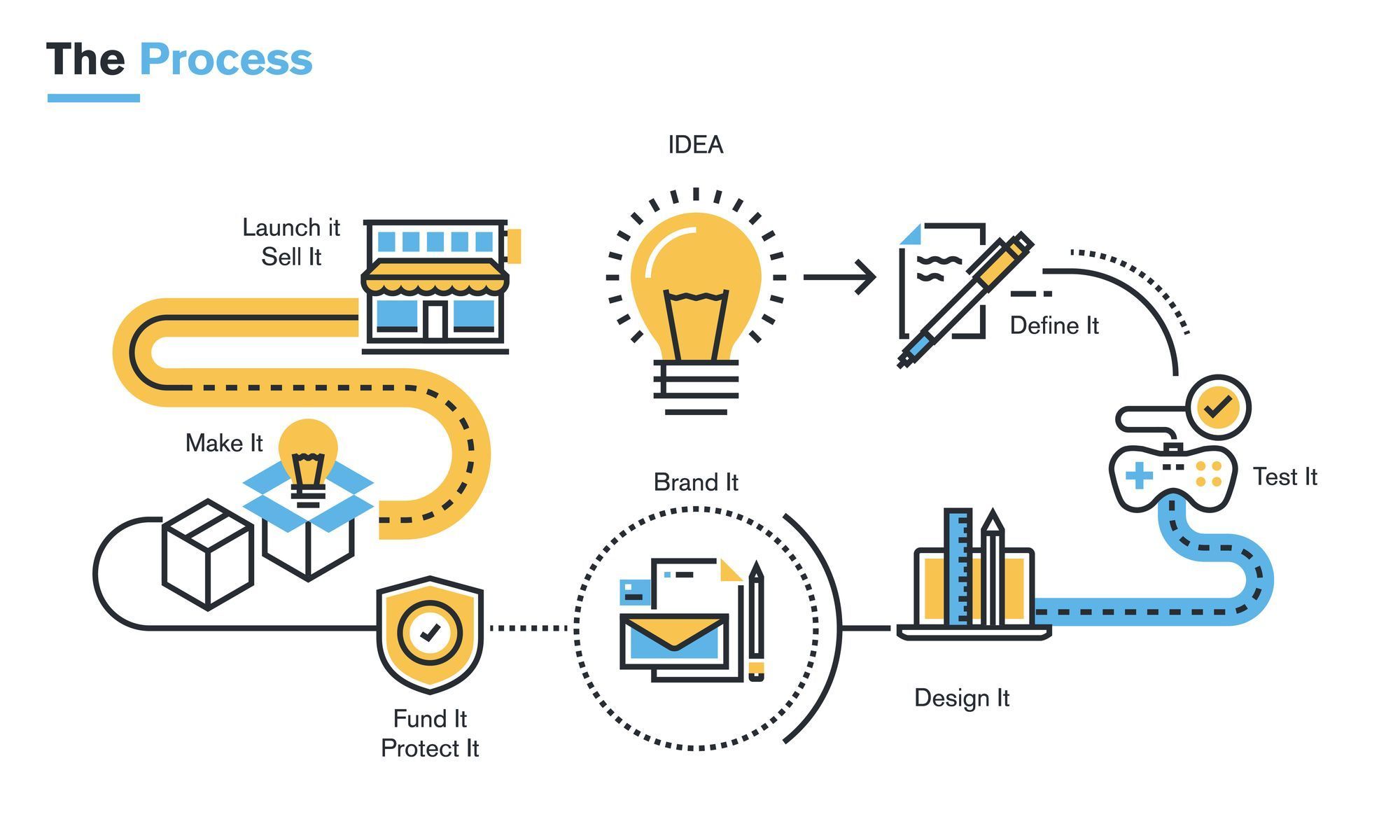
In simple words, Prototyping is an experimental process where design teams implement ideas into tangible forms, from paper to digital. Teams build prototypes of varying degrees of fidelity to capture design concepts and test them on users. With prototypes, you can refine and validate your designs so your brand can release the right products. When creating a software product, prototyping is the ideal way to test, evaluate, and validate your idea with users.
It lets you confirm that you are building the right product and features before you code anything. In other words, prototyping reduces project risk. You don't want to find out later months of costly developer time and budget that the features don't meet real user needs. Instead, starting with a prototype lets you get user feedback on what key features to build. As some developers like to say,
#### **"If a picture is worth a thousand words, then a prototype is worth a thousand meetings."**
#### **The importance of prototype in product design**
The major challenge for a designer or a developer is that he or she usually has to communicate the look and feel of the product to the product management team. UI/UX has so many aspects that highlighting the underlying core functionality while sharing designs with team members can be a struggle, thus, making it difficult for stakeholders to comment and give feedback. With prototyping you can combat all of this along with the following benefits:
#### **A better understanding of the design intent**
Prototyping not only presents a strong visualization of the design to understand the look and feel of the final product but it also helps the team to comprehend better why they are designing, what they are designing, and for whom they are designing.
#### **Early feedback**
One of the most important aspects of the product-building process is gathering feedback. With prototyping, you can collect reviews at every stage of developing the product — whether adding new features or redesigning parts of the product. Test what is working for the audience and what is not. Define goals with your team members, the management teams, external stakeholders, SMEs, etc., and come to the best collective decision.
#### **Early changes save time and cost**
Changes towards the end would mean not just radical restructuring but also more speculation and rework. With a preliminary model ready it is always possible to make the desired changes early because by that point no investment or effort has gone into creating the full product. Thus, early changes help you achieve your goals faster.
#### **Validation before development**
Prototyping allows having multiple discussions between iterations before getting into final development. This iterative process makes it easier for you to have surety in what you are building is actually what is needed. User research and user testing: Users are supreme. So identifying your prospective user set and collecting their ideas to serve them better is of utmost importance. Prototyping helps you achieve that. The ultimate intent of creating a prototype is user testing which tells you how usable and valuable your product is to the end user. You can gain inputs and insights about how real users would use the product in real-world scenarios and what you can improve to address their pain points.
#### **Types of prototyping**
A prototype enables our developers and designers to show our understanding of the customer’s requirements. If our interpretation of the requirements is off by just a little, the customer can see the discrepancy and let us know right away. Doing this early in the development process saves time, money, and aggravation. It’s much easier to make changes early in the development cycle.
The four common types of prototyping used in the software industry today are:
• Rapid (Throwaway) prototyping
• Evolutionary prototyping
• Incremental prototyping
• Extreme prototyping
#### **Throwaway prototyping**
What is rapid prototyping? The rapid (throwaway) prototyping approach is the quickest and the most financially affordable one. This prototype is completed within a short period and doesn’t have any real-world functionality, focusing solely on the design. This technique is used to collect feedback from the client and see whether the proposed design fits their needs and expectations. Once the revisions are made, and the confirmation is received, the coders start development from scratch without using the dummy prototype, referring to it only as a design model.
#### **Evolutionary prototyping**
As its name suggests, this type of prototype grows, or evolves, from some basic skeleton of the software product’s structure into something more complex and functional. Developers add features at each iteration to move to the outcome step by step. Evolutionary prototypes are working from their first stages of development, meaning that the client and developers can interact with them and test the developed features. Thus, using refining the prototype and advancing it, the software development team arrives at the final product.
#### **Incremental prototyping**
The evolutionary approach to prototyping looks more like a vertical process, with more complex features built upon the fundamental ones in the process of iterations, and the incremental approach results in a horizontal prototype. Developers break down the project into minor aspects that are later developed separately. Each separate feature is developed in its workable condition and tested separately, integrated with other features at the end of the development pipeline.
#### **Extreme prototyping**
This approach is more widespread in projects involving the creation of web app development. Apps typically include presentation and service layers; thus, the extreme prototyping method is structured according to this app architecture. Designers work on the HTML wireframe first, then transform it into functional pages, and afterward, add the services layer.
#### **Purpose of prototyping**
Some ask this question during their design development process: “What is the purpose of a prototype? It’s simple typically you are trying to solve a problem when developing a new idea. If you don’t build a prototype and test it how do you know it will resolve the issue you are trying to fix? Building a prototype allows you to try, hold, interact with, and get feedback. These are just a few basic but important reasons why building a prototype is imperative to the success of your product outcome.
Building a prototype allows you to measure data about your product you otherwise wouldn’t be able to get. It allows you to correct any issues, see and what works what doesn’t, to give the flexibility to make any major changes before final production. In some cases, you may even have to go back to the drawing board after your prototype is built.
#### **Main reasons why a prototype is needed**
#### **Accuracy**
Prototyping helps eliminate ambiguities. If there is any doubt, this is the time to get that resolved.
#### **Ergonomics**
With a prototype, you get to see if it fits well in your hands, on your body, or in space. Not only on your body but in many different body types. Prototyping helps define the correct ergonomics that your idea may need.
#### **Aesthetics**
A prototype can help you define the colors, textures, and materials needed.
#### **Survey**
A prototype is ideal to collect data. With it, you can survey people to get feedback.
#### **Pitch**
If you plan on showcasing your idea to potential investors or a company a prototype is a great way to introduce your idea.
#### **Testing**
A prototype helps you test your idea, if it works, or if it needs mechanical tweaks. This is probably the most important validation of your idea. If it works here you can improve its accuracy.
#### **Final consideration**
After, reading all of this you probably should’ve understood what prototyping is and how much significance it has in software development the prototype is an important step in the development of a product. To get through this phase correctly means having an almost finished product in your hands, which can demonstrate its potential success to investors and very first customers.
Successfully passing this stage means obtaining initial funding, starting to get people talking to each other, highlighting any problems, working on improvements, and preparing for smooth production. Therefore the prototyping of your product is a delicate phase, but one that will give you the satisfaction of seeing your idea transformed into reality. Take all the time you need and, if you think it is necessary, entrust yourself to expert hands.